The familiar snag is not always a shortage of volume. Sometimes it is a stack that must be dismantled, a shelf so deep that food disappears, or a drawer where every handle catches another handle. Treat these as access problems first. A useful arrangement lets you take out what you need and return it without rebuilding the cupboard.
Choose one small area for a trial. Empty it, clean it appropriately and separate what belongs elsewhere. Keep items you use together near the place you use them, while respecting safety and food-storage requirements. Cleaning products should not share food containers, and hazardous products must remain safely stored in their original packaging, away from children and pets.
Measure the path, not just the shelf
Record the clear width, depth and height of the usable space. Then look at the route through the opening. A door hinge can reduce clearance; a lip can stop a tray sliding; a pipe can prevent a box sitting flat. Measure with the door open in the way it will normally be used, not forced beyond its everyday position.
Allow space above the tallest item and around handles. A container that fits perfectly but cannot be grasped is a tiny domestic escape room. Test with a clean cardboard shape or an existing tray before ordering a fitted product. Do not put a temporary cardboard mock-up near heat, moisture or a moving mechanism.
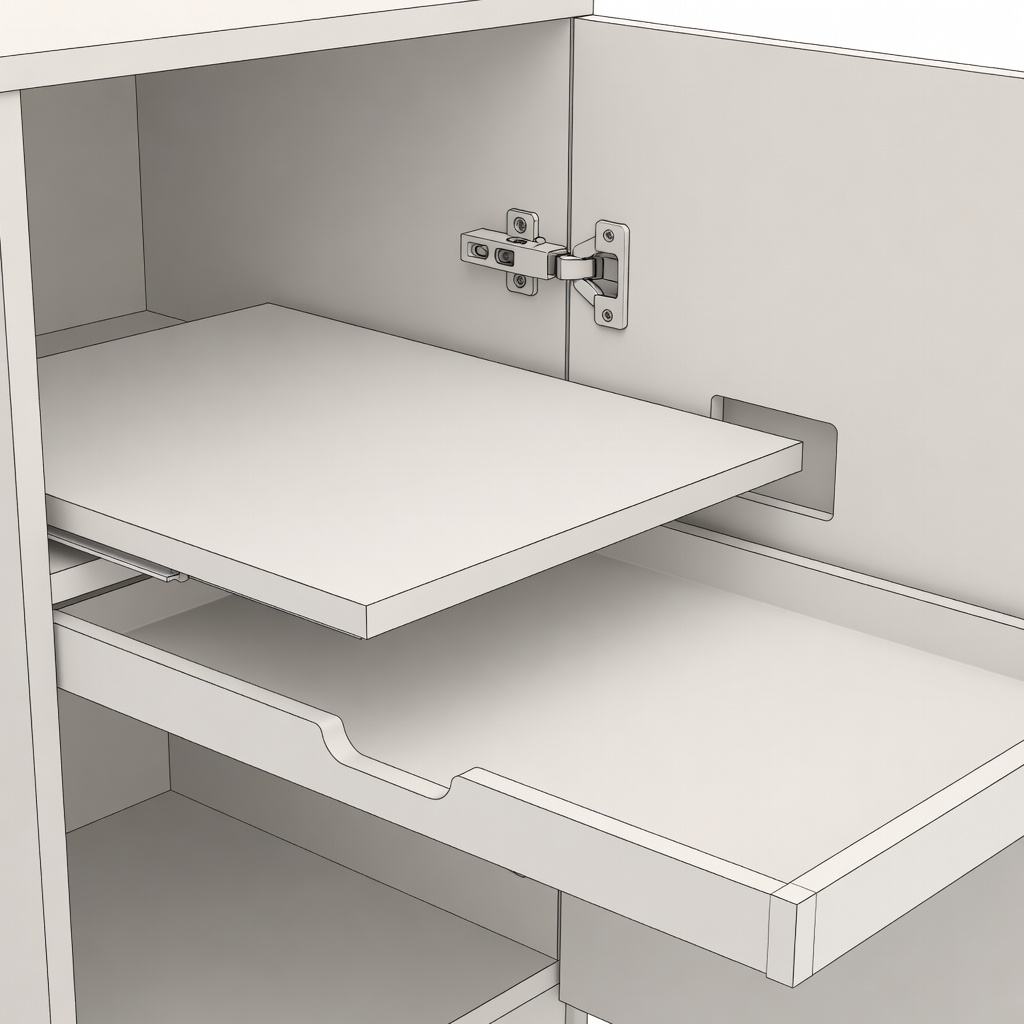
Give long tools their own lanes
Drawer dividers limit sideways movement. They work especially well when objects share a similar shape: long spatulas in one lane, measuring spoons in a shallow section, and small clips in a contained space. They do not make tall items shorter or fix worn runners. Check closing clearance before deciding that a new organiser has solved the problem.
Adjustable tension dividers press against the drawer walls. Use only where the drawer construction can tolerate that pressure, and follow installation instructions. Padded ends may reduce marking but do not prevent every dent or distortion. A removable tray is often a simpler choice for thin-sided drawers or rented furniture.
Make deep storage come forward
A handled bin gathers related items into a single movable group. Instead of reaching past several jars, you bring the group into view. The trade-off is weight: a tray full of tins can be awkward even if each tin is manageable on its own. Keep the load comfortable, avoid unstable stacks and use two hands when necessary.
A rotating organiser changes access by turning the rear items toward you. It does not increase the shelf’s physical area, and a circular footprint may leave unusable corners. Check the turning clearance with bottles in place, not just the diameter of the empty platform. Tall items can tip when spun quickly, so rotate slowly and avoid overloading.
Helpful arrangement
One shallow tray for items used together, with labels visible and space to lift the tray.
Looks tidy, works poorly
Several opaque boxes stacked above eye level, each requiring the others to be removed.
Vertical space still has physical limits
Shelf risers can separate layers without making a precarious tower, but their feet need stable support and their loads must stay within the stated limit. Keep heavy items low and avoid placing breakable containers where they are easily knocked. Do not use a shelf riser as a step or climb on furniture to reach storage.
Door-mounted organisers introduce leverage on hinges and can stop doors closing. Adhesive hooks depend on the surface, preparation, humidity, curing time and load direction specified by their manufacturer. A hook that holds a light cloth is not evidence that it will support a heavy appliance. Never mount hazardous, hot or breakable objects where a failed adhesive could injure someone.
Tall furniture may require anchoring according to its instructions. The U.S. Consumer Product Safety Commission’s Anchor It! campaign explains furniture tip-over prevention. Storage changes must also preserve escape routes, ventilation, appliance clearances and access to electrical panels and shutoff valves.
Run a one-week retrieval test
- Choose one task group. Start with tea-making supplies, lunch containers or baking utensils.
- Arrange with what you own. Use a sound, clean tray or box that suits the contents.
- Notice the awkward moment. Does something catch, tip, disappear or need two extra moves?
- Change one thing. Only buy a dedicated organiser when its dimensions and mechanism address that specific snag.
Labels are helpful when they describe a stable category rather than an idealised future habit. Leave a little spare capacity so returning an item stays easy. A storage system that needs constant attention has quietly become another household chore.
Further reading
- CPSC Anchor It!: furniture and television tip-over prevention
- National Fire Protection Association: home fire safety
- National Capital Poison Center — household poison prevention information.